

Description
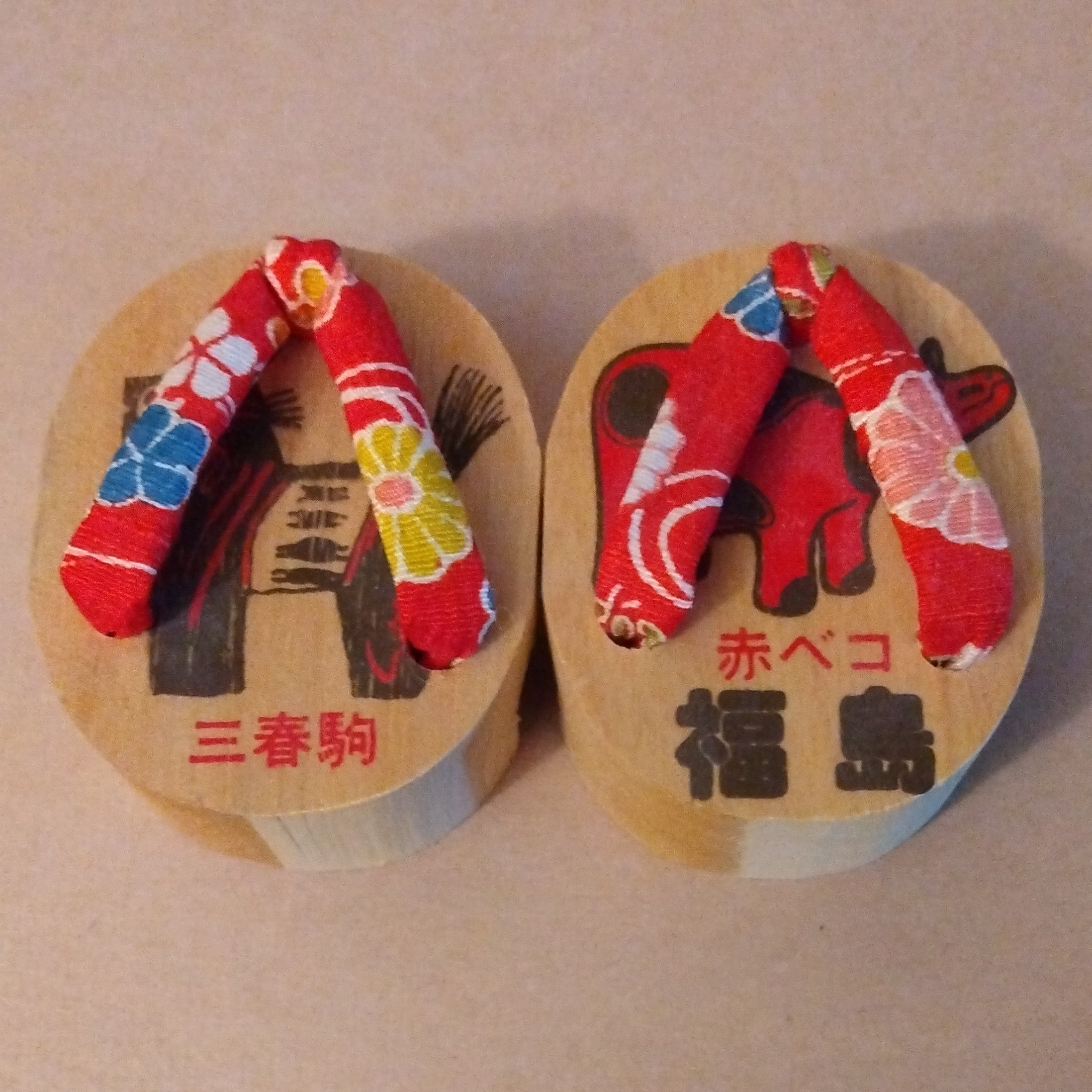
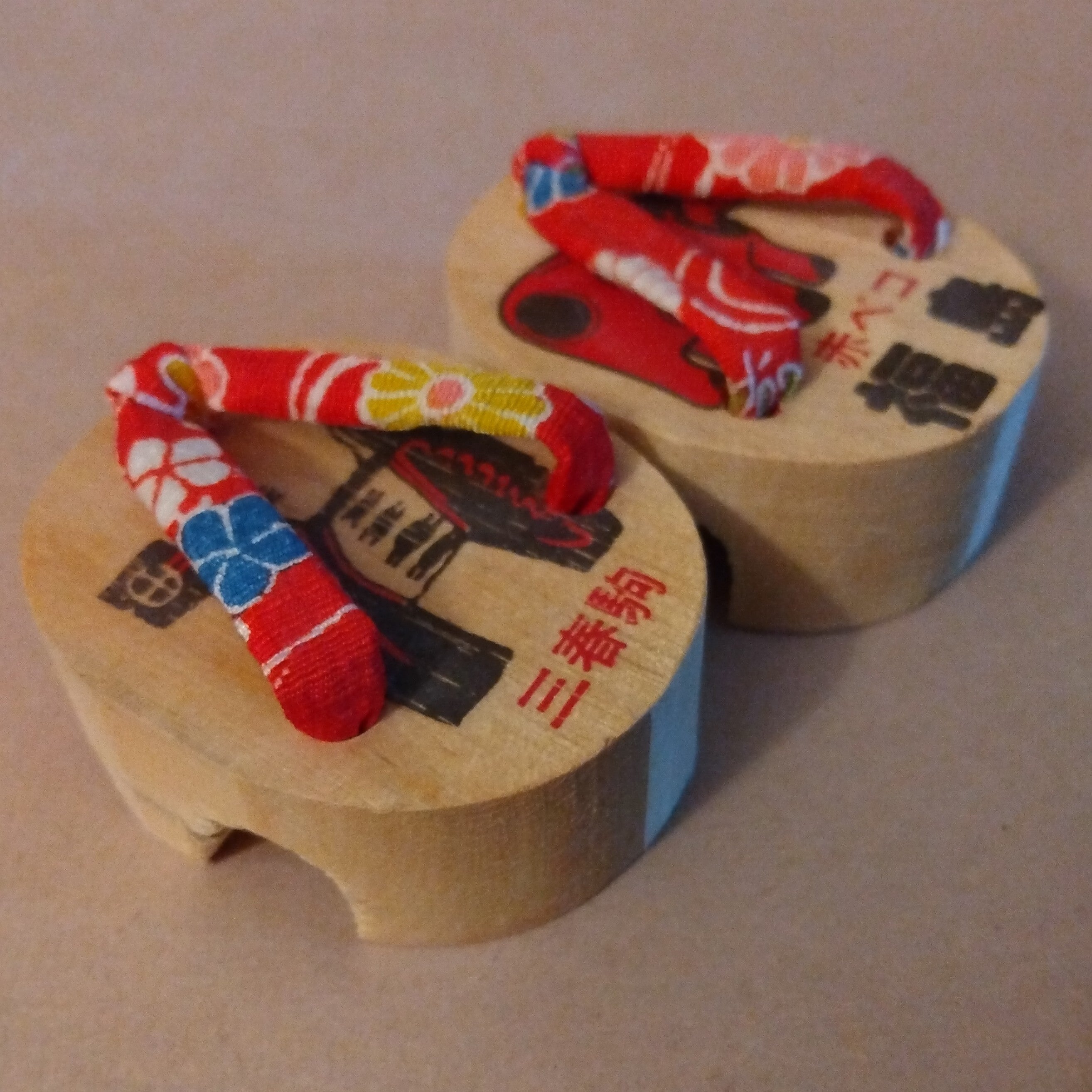
A miniature pair of "Geta"wooden sandals as a souvenir from Fukushima Prefecture featuring images of Miharu Koma (wooden horse of Miharu Village) and Akabeko (red cow, a symbol of the Aizu region), Vintage, late 20th C. H.1"(2.5cm) x L.2.125"(5.5cm) x W.1.75"(4.5c) [each]. Weight [combined] 28 grams. Wood, fabric, paint. Marked "Miharu Koma", "Akabeko", "Fukushima".
This cute "omiyage" (souvenir) of Fukushima Prefecture depicts two well-known folk toys and symbols of the region; the Miharu Koma and the Akabeko.
The legend of the wooden horse of Miharu Village goes back to the 9th Century and has long been a popular amulet and children's toy in Fukushima. A fuller description and history of Miharu Koma can be found at our listing for an actual wooden Miharu Koma doll can be found here.
The Akabeko, or "Red Cow" in the local Aizu dialect, is a lacquered papier-mache nodding head doll that also has a long history in Fukushima, going back to the late 16th Century, but also based on a legend from 9th Century. In 807C.E., during the construction of Enzou-ji Buddhist Temple in Yanaizu, Fukushima, a red cow refused to leave the temple grounds after construction was completed. The cow became a symbol of Buddhist devotion. In 1590, at the end of the Sengoku (Warring States) Period, when Toyotomi Hideyoshi solidified power over most of Japan, he sent Gamou Ujisato to be Lord over the Aizu region (which included present-day Fukushima Prefecture). Gamou heard the local story of the red cow and ordered his court artisans to create the Akabeko doll as a symbol of the area. A smallpox epidemic followed shortly after and it was claimed that children whose homes had the Akabeko doll were not afflicted (in ancient Japan, the color red was believed to have powers in warding off illness, thus many Japanese folk toys were red to protect the children who played with them). The dolls popularity as a talisman against illness spread, even beyond the Aizu region, and they continue to be popular today.